

Released in 2004, the original Star Wars Battlefront had one idea that was almost impossible to resist: instead of watching the huge battles from the films, it dropped you directly into them as one of the soldiers normally getting blasted somewhere in the background. No complicated loadout system. No hero points. No twenty-minute introduction. You pick a faction, choose a soldier, spawn at a command post and get blastin’.
Developed by Pandemic Studios and released on 21 September 2004, Star Wars Battlefront covered both the Clone Wars and Galactic Civil War, with the Republic, Separatists, Rebel Alliance and Galactic Empire all playable. Its main modes included Instant Action, Historical Campaigns and Galactic Conquest. Originally releasing on the OG Xbox, PS2 and PC, more than two decades later, plenty of it naturally feels old. The AI has its moments, weapon handling is basic compared with modern shooters, and Battlefront II expanded the formula enormously just one year later. Yet the original still gets something absolutely right, it makes you feel like one small part of a much bigger Star Wars battle.
Battlefront Was About Being a Soldier, Not a Superhero
One of the biggest differences between the original Battlefront and the games that followed is how little interest it had in making you the most important person on the battlefield. You were a Clone Trooper. A Stormtrooper. A Rebel soldier. A Battle Droid.
Each faction had five playable classes built around the same general structure: standard infantry, heavy weapons, pilot, sniper and a faction-specific special unit. That final slot gave each army some personality, with units such as the Republic Jet Trooper and the Separatist Droideka making the factions feel different without turning the game into a collection of wildly complicated character abilities.
The basic infantry class was your dependable all-rounder. Heavy units carried anti-vehicle weapons. Snipers were useful on open maps. Pilots could repair vehicles and turrets as well as keep themselves useful in a firefight. Then there were those special units.
Seeing a Droideka roll towards a command post, unfold and activate its shield could immediately change what was happening in that part of the map. Battlefront didn’t need dozens of classes because each one had a fairly obvious job. More importantly, changing jobs was painless.
If an AT-ST was causing problems, you could respawn as your faction’s anti-armour unit. If your team was losing vehicles almost as quickly as they spawned, switch to a pilot. If the enemy had left an approach exposed, grab a sniper.
Death wasn’t much of a punishment because you were never supposed to be one unstoppable character. You were another reinforcement. And Battlefront literally counted you that way.

Command Posts Are What Made Battlefront Work
Strip away the Star Wars licence and Battlefront’s most important mechanic is probably its command posts. Each team starts with a pool of reinforcements and control of several spawn points spread across the battlefield. Capturing enemy command posts gives your side somewhere new to deploy while gradually squeezing the opposition out of useful territory.
A position that feels completely secure can suddenly become the front line because the command post behind you has fallen. Capturing an apparently insignificant point can open a new route towards the enemy. Ignore the objective while chasing kills and you can find your team pushed back towards its final spawn. It gives Battlefront a little bit of strategy without ever becoming a strategy game.
Hoth demonstrates it perfectly. The Rebels aren’t simply firing at Stormtroopers until somebody reaches a kill limit. There are trenches, defensive positions, vehicles and command posts spread across a huge snowy battlefield while AT-ATs steadily advance towards Echo Base.
You might spend one life trying to destroy armour, the next defending a command post and the next desperately trying to recapture a position before the Imperial army takes complete control. There is always something happening somewhere else.
That’s important because Battlefront’s individual shooting mechanics were never particularly deep, even in 2004. The game works because those shooting mechanics sit inside a much larger battle. Sometimes the most valuable thing you can do isn’t kill another enemy. It’s stand inside a glowing command-post radius for a few seconds without getting shot. Not glamorous, perhaps. But the galaxy needs heroes.
Or at least somebody willing to capture spawn point C.

The Maps Made Each Battle Feel Different
This is an area where the first Battlefront deserves far more credit than simply being remembered as the game that came before Battlefront II. Its battlefields have personality.
Hoth: Echo Base is the obvious showcase, but it is far from the only memorable map. Geonosis: Spire gives the Clone Wars the scale it deserves, with infantry fighting beneath huge Republic and Separatist vehicles.
Bespin: Cloud City turns the game into something much tighter, with corridors, platforms and concentrated infantry fighting.
Endor: Bunker combines woodland combat with an Imperial installation.
Kamino: Tipoca City puts fights across exposed platforms surrounded by ocean.
Tatooine: Dune Sea throws players into a much more open desert battlefield.
Rhen Var gives the game something particularly valuable: locations that don’t simply feel like recreations of famous film scenes.
The original Battlefront includes battlefields across Bespin, Endor, Geonosis, Hoth, Kamino, Kashyyyk, Naboo, Rhen Var, Tatooine and Yavin IV, with Jabba’s Palace later added to the original PC game through an update. Some maps are unquestionably better than others, but they rarely feel interchangeable. Vehicles help enormously with that.
Battlefront lets you climb into AT-ATs, AT-STs, speeder bikes, tanks and numerous starfighters depending on the battlefield. The original game’s Steam listing advertises more than 30 vehicles, including X-wings and Snowspeeders. Crucially, many of those vehicles exist directly inside the same battle as the infantry. You’re not loading into a separate vehicle mode. You’re running towards a command post while somebody flies overhead, a tank rolls past and an enemy missile suddenly reminds everyone why standing next to an armoured vehicle isn’t always a brilliant idea.
That unpredictability is a huge part of Battlefront’s charm.
Galactic Conquest Gave the Battles a Reason to Matter
Instant Action is excellent when you simply want to choose a map and start shooting things. Galactic Conquest is where the original Battlefront becomes dangerously easy to keep playing. The mode places a simple strategic layer over the normal battles. You select a faction, fight for control of planets and gradually try to dominate the galaxy.
It isn’t Total War with Stormtroopers. There are no sprawling technology trees, detailed economies or diplomatic systems. Instead, planets provide bonuses that can be used to influence future battles. Capture Naboo and you can gain Bacta Tanks, allowing troops to regenerate health. Bespin provides Sabotage, causing enemy vehicles to enter battle already damaged. Kashyyyk can provide additional reinforcements, while Tatooine’s bonus allows your faction’s Jedi hero to join a battle.
It’s simple enough that you can understand the entire idea within minutes. That’s why it works. Winning a normal Instant Action battle is satisfying. Winning because you’re trying to secure Naboo before the enemy does gives the exact same match a little more purpose. You start thinking one battle ahead.
Do you attack the planet with the useful bonus?
Do you defend what you already control?
Which advantage is going to help on the next battlefield?
None of these decisions will keep a grand-strategy player awake at night, but they connect Battlefront’s individual maps into something bigger. It also produces that dangerous old-school gaming thought: “One more planet.” Then suddenly it’s considerably later than it was supposed to be.
If Galactic Conquest leaves you wishing somebody would take Star Wars strategy much further, we’ve also looked at exactly what we’d want from a proper Star Wars Total War game.
The Original Battlefront Did Heroes Differently
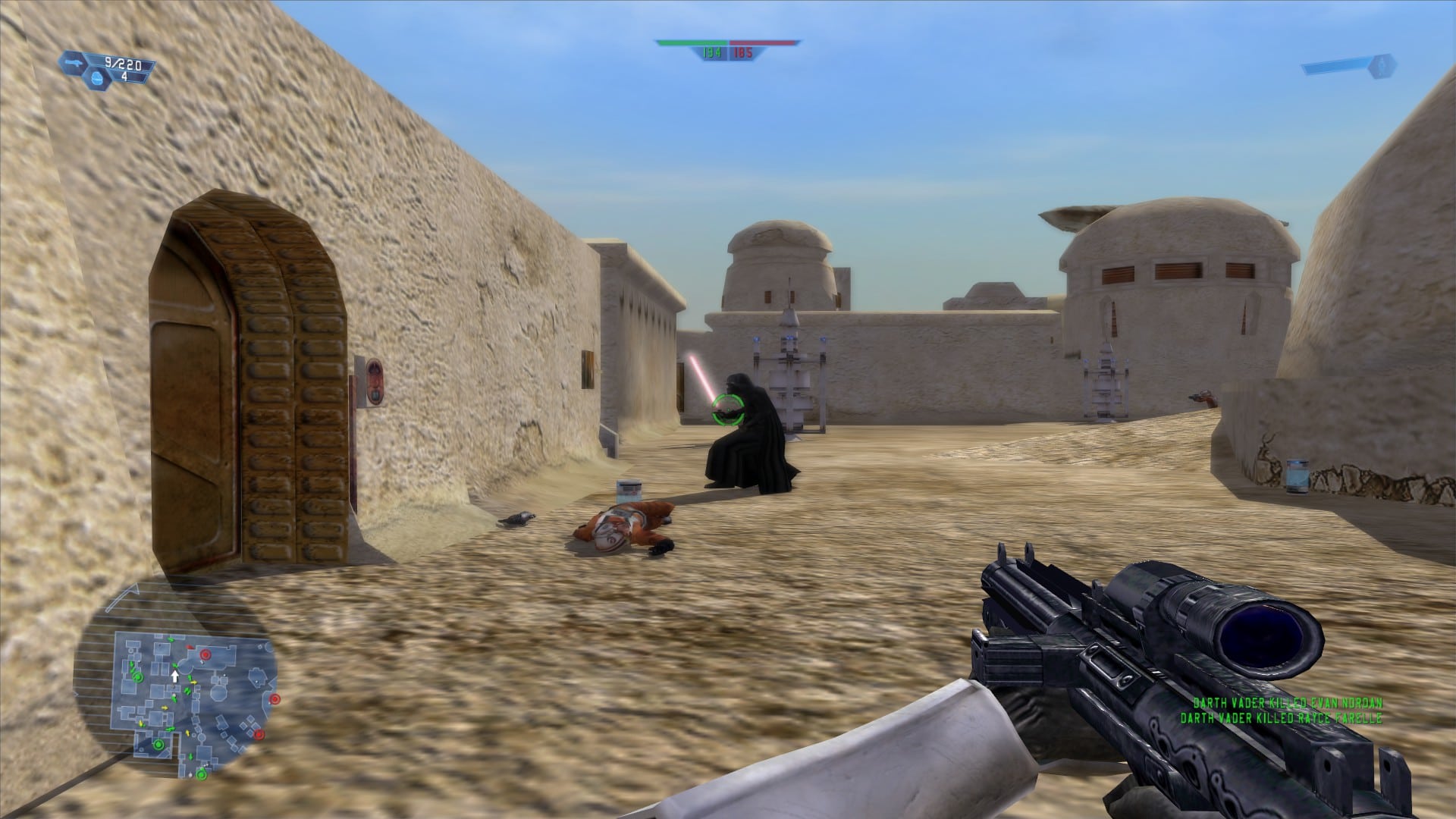
If you started with Battlefront II or EA’s later games, this can initially feel bizarre. You cannot normally play as the Jedi and Sith heroes in Battlefront 2004. Characters including Darth Vader, Luke Skywalker, Mace Windu and Count Dooku can appear on the battlefield as AI-controlled allies, but they aren’t another class waiting for you to select.
At first glance, that sounds like an obvious weakness. Battlefront II allowing players to actually control heroes is undeniably one of the sequel’s biggest additions. But the original approach has an unexpected benefit, Darth Vader feels frightening because he isn’t you. You’re still the Rebel soldier desperately trying to capture a command post while a seven-foot Sith Lord marches towards everybody.
The focus remains on the armies. The Jedi are almost environmental hazards dropped into the middle of them. It’s another example of how committed the first Battlefront was to its original fantasy: this isn’t Luke Skywalker’s battle. It’s yours. And you’re probably not surviving it.
Battlefront II Is Bigger – But That Doesn’t Make the Original Redundant
There is no point pretending Battlefront 2004 contains everything its sequel does. It doesn’t. Battlefront II expanded the series with playable heroes, space combat, a more developed campaign and additional systems. For many players, it quite reasonably became the definitive version of Pandemic’s Battlefront formula.
If somebody could only play one of the two games, Battlefront II would be an easy recommendation. But that doesn’t mean there’s no reason to play the original. The first Battlefront has a slightly different rhythm. There is less distraction from the basic war over command posts. Heroes don’t dominate the match. Several of its battlefields have their own identity, and the combination of infantry, vehicles and simple territorial control gives it an almost sandbox-like quality. Sometimes the simpler idea has its own appeal.
The Weaknesses Are Much More Obvious in 2026
Nostalgia shouldn’t get Battlefront completely off the hook. The AI is probably the biggest problem. Computer-controlled soldiers can be useful enough to make a battlefield feel populated, but don’t expect tactical brilliance. Friendly forces can make strange decisions, important positions can be abandoned and battles occasionally swing because your artificial teammates have collectively decided to be somewhere else.
That criticism isn’t purely hindsight either. Contemporary reviews praised the premise and multiplayer battles while pointing towards shortcomings in the single-player experience and AI. GameSpot’s original 2004 review described it as a satisfying team-based shooter while noting how heavily its appeal depended on the Star Wars setting and multiplayer-style design.
Combat is also extremely straightforward by modern standards. Weapons don’t have the depth or feedback you’d expect from a newer shooter. The Historical Campaign is more a sequence of battles based around familiar Star Wars events than a deeply authored narrative campaign. And Galactic Conquest, as enjoyable as it remains, is ultimately very lightweight. Play for long enough and repetition inevitably creeps in.
Can You Still Play Star Wars Battlefront 2004 Today?
For PC players, the original standalone Star Wars Battlefront (Classic, 2004) remains available on Steam. Its Steam page currently lists single-player and online PvP support, and the game still carries an Overwhelmingly Positive English user-review rating, with 96% positive reviews when checked in October 2026.
There is also Star Wars: Battlefront Classic Collection.
Released in 2024, the collection packages the original Battlefront and Battlefront II together for PC, Nintendo Switch, PlayStation 4, PlayStation 5, Xbox One and Xbox Series X|S. It includes online support for up to 64 players along with content from both Pandemic games.
If your main interest is specifically Battlefront 2004 on PC, the standalone Steam version remains an obvious option.
If you want both Pandemic games on newer console hardware, the Classic Collection provides the convenient modern package.
Either way, the original is far easier to revisit today than many games from the same console generation.
Is Star Wars Battlefront 2004 Still Worth Playing?
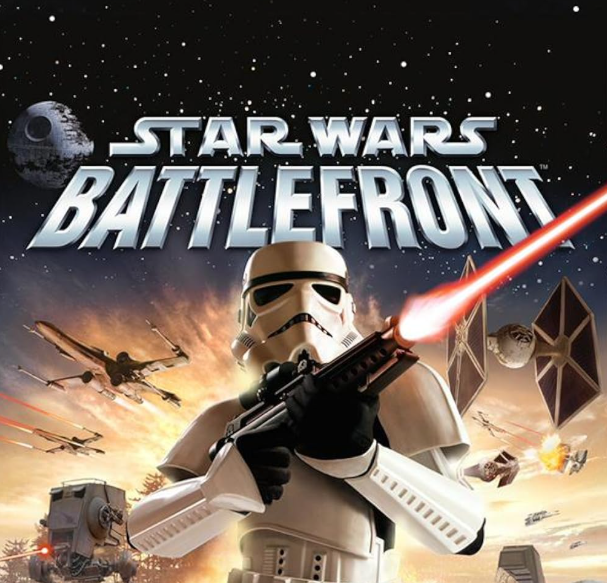
Yes, particularly if what you want from Star Wars is the war rather than just the heroes. Battlefront II is bigger. Modern Battlefront games are prettier. Newer shooters have considerably deeper weapons and progression systems. None of that completely replaces what Battlefront 2004 does well. Its command posts create constantly moving front lines. Its vehicles make maps feel unpredictable. Galactic Conquest gives otherwise disconnected battles just enough strategic context. Its factions are different without becoming complicated. And its refusal to make the player the centre of the Star Wars universe actually makes the battles feel larger.
You aren’t necessarily Luke Skywalker saving the galaxy. Sometimes you’re a Rebel Trooper on Hoth who has just spawned miles away from where you wanted because the Empire captured the wrong command post. And somehow, that’s exactly why it works. More than twenty years later, the original Star Wars Battlefront remains simple, occasionally clumsy and absolutely capable of producing the kind of Star Wars battle that makes you immediately queue up another map.